MARGARET THATCHER MEETS MEDEA: Witches and Monstrous Mothers throughout the Ages.

Tags

, , , , , , , , , , , , , , , , , , , , , , , , , , , , , , , , , , , , , ,

lucyMargaret Thatcher is nothing, if not memorable.  She is both loved and reviled, depending on which side of the fence you stand on.  It is not my intention to pay a tribute, though it does seem like a fitting topic this week, following the death of Thatcher, to discuss legendary women who fall into the category of ‘monstrous mothers’.  Their deeds are outwith the accepted boundaries of what it means to be a woman.  They, therefore, become known as a witch or monster.

Medea, wife of Jason, in the classical tale of the same name, is one such witch.  Written in 431 BCE by the Greek playwright Euripides, Medea tells the story of a foreign witch betrayed by the man she loves.  She gives up everything, her wealth and status, for Jason; everything, that is, except her magic.  In fact, Medea is a priestess of Hekate from Colchis.  This was the special domain of sorcery known as Kolkha.  In the 6th century BCE Colchis came under the Persian Empire†.  In Greece, foreign religions were treated suspiciously and given the name ‘magic’; terms which arose from the name of the Persian priests, The Magi.  Medea is treated badly throughout the story, both by the suspicious women of her new town and from her once beloved Jason.  The townswomen do not like that Medea dresses differently from them; and Jason betrays her when he decides to marry Princess Glauce.  Glauce is deemed to be more of an appealing match.  After all, Medea is only a ‘barbarian woman’ in the eyes of the Greeks.  By this point in the story, Medea has raised Jason’s two sons, and gets her own appalling revenge on him by murdering his wife and her father on the wedding day.  She goes on to murder the two sons that she and Jason have together.  Medea is shown, however, to be an oppressed victim, appealing for the sympathy of the audience. In this tale, she escapes in a blaze of glory, astride dragons, having wreaked her revenge on the philandering Jason.  

The Sun himself, the source of all life and warmth, vindicating the cause of passion, disorder, violent cruelty, against the cold, orderly, self-protective process of civilised man, is a reminder that the universe is not on the side of civilisation; and that a life combining order with happiness is something men must win for themselves in continual struggle with an unsympathetic environment. (1)

This week, I’ve read the line: “Ding dong the witch is dead…” so often I can’t now seem to get it out my head.  Interestingly, it was not until The Wizard of Oz, that we had the introduction of the witch as a terrifying character on the silver screen. 

The witch has always inspired dread and fear, going back to ancient times, as can be seen in the case of Medea.  The earliest known witches were feared only because they were thought to have magical and terrifying powers, not because of any association with The Devil.  This was a later-added Christian fear (both The Devil and the association of The Devil with witches).

In some cultures, young girls who experienced prophetic dreams during menstruation were thought to be witches.  There was often this association with blood and the supernatural.  Menstruation was linked to the ‘witches curse’, something Stephen King explored in his much celebrated story Carrie.  Historically, the curse of a woman who was menstruating or pregnant was believed to be much more powerful.  It was known as a ‘Mother’s Curse’, and meant certain death.  In the 14th century, the secret feminine knowledge of midwifery became associated with witchcraft and in 1484 The Malleus Maleficarum stated that witches were castrators.  Clearly men, therefore, had much to fear from these devil women!  Witches, during those years, were often accused of such things.  The main reason given for a woman’s ‘otherness’ is her natural carnal nature.  Here is a shining example of the demonisation of women and sex, rolled into one convenient package.  Burn the horny cock-thieving bitches!

In horror, the witch still has an essentially sexual nature, with supernatural powers and a wish to harm, wreaking destruction on the community.  Being closer to nature than man, she can control such things as storms and hurricanes.  In Carrie, the anti-heroine is a young menstruating woman, although not a mother.  The monstrous mother role is given to her mother, who desires to control her daughter through a warped sense of religious morals.  At no point in the story does she ever really show a maternal bond with Carrie.  In both Psycho and Carrie the monstrous child is a product of the psychotic, domineering and monstrous mother.  There is, incidentally, another important similarity between Carrie and Psycho.  Both Marion in Psycho and Carrie, are punished severely after enjoying sensual pleasures in the shower, and both these scenes end in blood-shed. 

Having been given no prior warning about periods from her mother, Carrie is then subjected to a lecture on the sins of women when she returns home.  Raving about sexist religious beliefs, Mrs White goes on to blame all human evil on women.  Woman is the universal scapegoat, and Carrie is, therefore, the sacrificial victim at the Prom, where she is baptised in the blood of a pig as a joke by her bullying classmates.  Carrie is ‘crowned queen and anointed with pig’s blood’ before going on to wage her terrible and monstrous revenge.  Like Medea, we are encouraged to view her display of monstrosity with sympathy because, like Medea, Carrie has been treated appallingly by her female peers and (not her husband) her mother.

Both women desire a fresh start at the end of their vengeful outburst: Medea in Athens, and Carrie, pictured as a trembling child washing off the indicators of her womanhood, kills her mother and returns to the ‘womb’ of the dark closet.

It’s pretty safe to conclude that the monstrous female is a patriarchal invention.  Women tend not to be frightened of themselves, usually.  In horror, the monstrous nature of women is undoubtedly linked with her place as man’s sexual other (2).

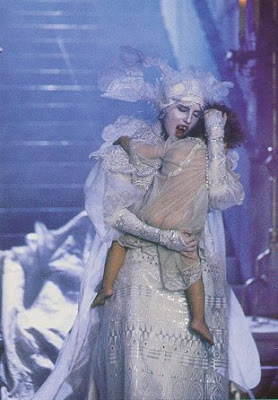
The dark side of maternity is also explored in Bram Stoker’s Dracula.  The Count, described by Almond as a ‘monstrous baby’, suckles on women, turning them into bad mothers: ‘non-maternal sexual predators’ such as the vampirised Lucy, is later destroyed by honourable men.  Furthermore, the three female vampires encountered by Jonathon Harker are representative of rampant female sexuality, much reviled by Victorian society.  In such a society, they symbolise the corruption of motherhood.  With witch-like qualities Shakespeare would have been proud to see, the terrifying power these three possess is female sexuality.  Furthermore, Lucy goes from unconscious flirtatiousness to becoming blatantly seductive and, therefore, dangerous.  Shortly after her death there are newspaper reports of children going missing who later, returning with bitten necks, report having met a beautiful woman who turns out to be Lucy.  When confronted vampirising a child at night, Lucy callously discards the child and attempts to seduce her husband, Arthur.  This is a scene which shows female sexuality is incompatible with maternity, a strong Victorian notion.  It also reverses the roles of the mother and child.  Instead of the child feeding from the mother-figure, the mother feeds upon the child (3).

Powerful and/or sexual women are often seen as a threat to a patriarchal-dominated society, whether or not they and their behaviour deserves to be viewed as ‘monstrous’.  Like her or loathe her, Margaret Thatcher was a successful politician from the late 1950s, gaining the ultimately most powerful position possible in 1979 when she became Prime Minister of the UK.  Thereafter, she became a Monstrous Mother, suppressing the power of her ‘children’, sending them to be killed in unnecessary wars, increasing their poverty and manipulating them with well-timed elections.  Eventually, 200,000 of Maggie’s children demonstrated against her policies.  There’s definitely a gothic horror story in that!  I doubt, however, that Maggie would get as much sympathy as Medea or Carrie… 

I’m not sure either if she had an ‘essentially sexual nature’, though no doubt she was the wank fantasy of some BDSM pervs…

Well, anyway, I’m even more grateful to have such a loving mother when you see what’s out there!  Mine even gave me a kidney – she’s a keeper!

Until next week: More power to MILFs!  Your friend, A.D.


(1)               Euripides, Medea & Other Plays Penguin (1963 edition) p9.

(2)               Creed, B   (1993) Woman as Witch in “The Monstrous Feminine: Film, Feminism, Psychoanalysis” Routledge pp73-83.

(3)               Almond, B R (2006) Monstrous Infants and Vampyric Mothers in Bram Stoker’s Dracula in “The International Journal of Psychoanalysis” 2007:88:219-35.

† The Making of the Georgian Nation: 2nd Ed, Ronald Grigor Suny, p 13

FEAR, RELIGION & EXORCISM: Demonic Possession and the Battle of Good vs. Evil in Horror

Tags

, , , , , , , , , , , , , , , , , , , , , , , , , , , , , , , , , ,

EXORIST, I.V.(Contains Spoilers!)

I read two things this week that made me decide to write about the role of religion in horror.  Firstly, my idol Gabriel Byrne said that he thought the Catholic Church was evil.  Secondly, parks have a calming effect on the mind, apparently!  What have these got to do with one another?

Well, although I’m pagan I have to both agree and disagree with Gabriel.  Religion, like every entity, has a good and a bad side.  Both positive and negative psychology exists in most religions.  Many people have horrific or depressing experiences within the confines of a place of worship or due to the beliefs held, but just as many have hugely fulfilling life-long relationships with their God(s); despite my lack of Christian belief, I never fail to feel spiritually at peace in beautiful big Italian churches.  They are designed that way deliberately, to give you a sense of peace.  In much the same way as Nature is.

Over the years, many stories have been penned on the fight between good and evil.  Like all horrors, they are intended to frighten the reader, or viewer.  What better way to terrorise than through deep-rooted religious beliefs and superstitions?  Therein, lie many supernatural beings, ready and willing to take your soul.  The gothic horror novel can be scrutinised for the plentiful evidence of the much larger fears of society, and the horror genre in general is awash with (often) Christian symbolism.  Sometimes, if it’s being especially clever, a story will throw in the debate of religion vs. science, with psychology being the obvious choice for the reasons behind baffling and frightening behaviour.

Truth be told, religious horror absolutely scares the beejeezus out of me, but I absolutely love it.  Religion was never forced down my throat as a kid, so I can only imagine how devout Christians feel!  I know many Catholics who just won’t watch or read, for example, The Exorcist, even though I tell them the Church is painted in a very good light and defeats Satan in the end.  I first remember reading The Exorcist as a teenager, probably around the age of fifteen or so.  It was a book given to me by my grandfather, who knew I liked Hammer Horror and Christopher Lee.  My love of The Count was positively encouraged by my father, and I have many fond memories of our Dracula film nights!  I don’t think my grandfather had any idea of what The Exorcist was about, or what lurked between the pages of that book.  I’m sure he’d never have passed it on otherwise.  I found it shocking, disturbing and highly entertaining, though it might have caused me some bouts of insomnia for a few weeks!

The Exorcist is the tale of a little girl, who becomes possessed by the Devil, and the fight of the priests to save her soul.  The author, William Peter Blatty, supposedly derived inspiration from the exorcism of a young boy by a Jesuit priest in 1949.

However, Blatty chose not to go with Christian mythology when deciding on which evil spirit to use.  The demon he chooses for his story is Pazuzu, a wind demon from Babylonian and Assyrian mythology.  Demons, in ancient Iraq – where the story begins – are also called Djinn or, as we know them, ‘genie’.  The genii in Assyro-Babylonian mythology were inferior to gods but played a major role in the daily lives of this ancient civilisation.  There were both good and bad genii.  The good ones were guardian spirits, but there were also evil genii from the lower world who overwhelmed people with disease, made them become criminals, split up families and decimated livestock. There was no way of appeasing them, and it was thought they did not heed either prayer or supplication.  Seven of them were thought to be particularly dangerous: ‘…they dwell in holes in the ground, they live among the ruin of the earth’.  They appear to mortals as terrifying creatures and can only be driven away by incantations performed…by an exorcist! (1)

Father Merrin, in The Exorcist, finds a small statue of Pazuzu and a St Joseph’s medal whilst on an archaeological dig in Iraq.  Immediately the story is introduced as the fight for good against evil.  As this is happening, in Georgetown (USA), a little girl and her mother start to experience disturbing events.  As the story progresses the little girl, Regan, appears to be possessed by a demonic entity.  Her mother immediately has various psychological tests carried out, as this is the obvious reason for her daughter’s behaviour.  Eventually, at her wits end and seeking out another cure, she enlists the help of Damien Karras, a Jesuit priest trained in psychiatry; someone with a foot in both camps.  Damien, however, is easy emotional prey for the demon.  He has a crisis of faith and is guilt-ridden about the death of his mother.  The Vatican enlist Merrin, an experienced exorcist, to drive the demon out of Regan and save her from the Hellishness she has succumbed to. The outcome is the death of Merrin and the ultimate sacrifice of Karras, who persuades the demon to take him instead of Regan.  He then jumps out of the girl’s window, in an attempt to kill Pazuzu….

…and we think that’s it, until Legion (Exorcist III), also written by Blatty, but this time directed by him too.  It is also a pretty good film.  Particularly terrifying in this story, is the notion that evil has the ability to enter holy places, which most people like to believe are calm and spiritual havens of protection.  Suddenly, nowhere is safe from evil and chaos, neither churches nor hospitals; devout clergy are as vulnerable as anyone from attack by powerful evil spirits.

Police are baffled when the trade-marks of the now dead Gemini Killer, which were kept secret, start appearing on victims’ bodies.   It turns out to be a demon (presumably Pazuzu) possessing different people, making them commit horrific murders.  It also turns out Damien didn’t die, but is still possessed by the spirit of a serial killer alongside Pazuzu.  Damien is trapped in Hell, but still saves the day in the end.

I think this film is an absolute gem. The tension built up in some scenes is very well done.  The “Nurse Scene” scared the crap out of me when I first watched it, and again when I watched it this very afternoon – even knowing what was coming.  It is creepiness at its very best.  The film won a much deserved Saturn award from the Academy of Science Fiction, Fantasy & Horror Films, USA for Best Writing.  The acting of Brad Dourif, for which he at least received a nomination, is utterly fantastic.  It definitely should be on your list of books to read, and films to see.†

Another exorcism story, which keeps me awake and terrified, is The Exorcism of Emily Rose.  Again, it is good vs evil, science vs religion.  What I love about this story is that it leaves you to make up your own mind about the events that occur.

These events are based on the true, and very tragic, story of Anneliese Michel, an unfortunate German girl who died following an exorcism.  It is thought, by some, to have been a case of misidentification of mental illness, negligence, abuse and religious hysteria (2).  In the film, it is brought to the attention of a jury, and there is a fairly good case on both sides.  The outcome is similar to the real outcome.  In the film the exorcist is found guilty, but deemed to have suffered enough.

What I loved about this story is that it really draws upon the viewer’s beliefs at every point.  It borders, like the best scary stories, on the edge of possibility; because the events, or ones very similar, actually took place.

What do I believe?  I believe that demons and mental illness are the same thing dressed in different clothing, and I believe that in order to defeat anything you need to start with the beliefs of the affected person and adopt a holistic approach to treatment.  The real horror is that science and spirituality seem to be forever at war, rather than forming an amicable ‘opposites attract’ partnership, defeating the cause on all sides – physically, mentally and spiritually.

Yes, I believe… I believe in death. I believe in disease. I believe in injustice and inhumanity and torture and anger and hate.  I believe in murder. I believe in pain. I believe in cruelty and infidelity. I believe in slime and stink and every crawling, putrid thing… every possible ugliness and corruption, you son of a bitch! I believe…….in you (Lt. Kinderman, Exorcist III: Legion)

And I believe, even if you don’t believe, it is best not to be too arrogant about it.

Until next week readers.  Your friend, A.D.

  1. New Larousse Encyclopedia of Mythology (1986 edition) Guild Publishing: London p65.
  2. – Duffey, John M. (2011). Lessons Learned: The Anneliese Michel Exorcism. ISBN 978-1-60899-664-3

–     http://en.wikipedia.org/wiki/Anneliese_Michel

† And what of The Exorcist II…? Well, we don’t really like to talk about it…

Werewolves: Narrative and Symbolism in Film and Literature

Tags

, , , , , , , , , , , , , , , , , , , , , , , , , , , , , , , , , , , , , , , , , , , , , , , , , , ,

werewolf

By Sergey Kalinen

Werewolves!  Where does one start?!  These supernatural creatures have as vast and varied a history as vampires, probably even more so.  Early tales of transformation from man to wolf, can be read in the classical literature of Herodotus, Pausanius, Ovid, Virgil, Pliny the Elder and Petronius.

Depending on which part of the world you live in, the curse of the werewolf is either given by God or the Devil. Also, depending on which part of the world you live in, humans may metamorphose into any number of creatures.  In Europe, and subsequently Canada via Viking migration, America via European migration, Haiti via French migration etc, wolves are the most likely     were-animal.  Were-cats are also mentioned in the texts.  In Europe they are mostly associated with witches, whereas in Africa and Asia they are mostly associated with big cats – weretigers and werelions.  Werejaguars are also mentioned in the Americas.  In Thailand, there are even folk tales of werecrocodiles!

There seems to generally be a big difference between werewolves of film and werewolves of literature.  For example, in film werewolves are most often infected or cursed from being bitten or scratched by another werewolf.  In literature, they are cursed through a pact with the Devil, parentage or because they have a psychiatric illness (lycanthropy); also, in literature, religious symbols are usually no protection whereas, for example, a pentagram was used in the film An American Werewolf in London.  Traditionally used as a symbol for protection, it is often misunderstood to mean something Satanic.  In later (20th century) literature, the silver bullet was added as a means of killing a werewolf.  Prior to that, wolfsbane and exorcism were often tried on people believed to be lycanthropes.

From the original texts to current visual storytelling, it should by now be obvious that werewolves represent many varied things, and I’m not going to get too arsy about the differences because as I see it, most stories evolve and metamorphose themselves in the process.  Plus, films have to be written by someone before being put on the screen….

It has been suggested that rabies is one origin of werewolf beliefs.  It’s a great hypothesis, and there are several aspects of infection and symptom that would suggest this theory is correct.  Even though being bitten and infected was a later addition, and not present in origin myths and legends, the infection does curse the victim to a state of madness and is also often associated with canines.

Another possibility for the origins of the werewolf legends lies with the medical condition hypertrichosis.  This condition is caused by a genetic mutation of chromosomes, as well as various diseases such as cancer and anorexia.  In the most severe cases, the face and body are covered in thick hair, giving a very animalistic appearance.  In days gone by, people who suffered from this condition often ended up in circus shows, labelled with such names as “Wolf Man”.

Thirdly, The Berserkers, were Viking warriors described in Old Norse literature who dressed in wolf and bear skins.  They were said to enter an almost uncontrollable, trance-like fury, thought by some historians to be induced by drugs.  In one saga, they are described as being “tasters of blood”.  Their fit of madness is described here:

This fury, which was called berserkergang, occurred not only in the heat of battle, but also during laborious work. Men who were thus seized performed things which otherwise seemed impossible for human power. This condition is said to have begun with shivering, chattering of the teeth, and chill in the body, and then the face swelled and changed its colour. With this was connected a great hot-headedness, which at last gave over into a great rage, under which they howled as wild animals, bit the edge of their shields, and cut down everything they met without discriminating between friend or foe. When this condition ceased, a great dulling of the mind and feebleness followed, which could last for one or several days.(1)

This is interesting, in that not only do the Berserkers transform in the same way as werewolves do, but they are also weak when the effects wear off, in the same way that werewolves appear to be weak when they transform back to their human form.  The state of going ‘berserk’ is explored in Finding Delphi, when one of the protagonists is forced to confront his past and the guilt that remains with him because of his actions.  The effects of a hallucinogen experienced by him and other protagonists in the story, cause him to shapeshift into various animals, including a wolf.

The werewolf, in storytelling, has to be some part of the human being – a part of us which is deep-rooted and potentially accessible.  In some cases, it could be madness, and we have the full moon symbolism to thank for the association with the lunatic.  The word luna is Latin for moon and the goddess of the moon.  It is also, incidentally, the alchemical name for silver!  The full moon has long been associated with psychiatric illness.  It has never been proven to be anything more than a mythical link, although there is no accounting for the effect belief has on a subject.  In American Werewolf in London, the unfortunate David Kessler suffers psychologically through nightmares and supposed hallucinations, after straying off the path onto the moors, disregarding the full moon and being attacked by a werewolf which kills his friend, Jack, and turns David into a werewolf.  His reign of terror throughout the streets of London seems to be linked to delinquency and hooliganism, with some transvestism, anarchy and porn thrown in for comic effect.   In this case, the werewolf is the parts of an eighties society that London was either uncomfortable with or did not take very seriously, possibly both.  Certainly it represents the ‘Other’ in that society.

As well as furious, strange and criminal behaviour, the werewolf represents our most base instincts; our untamed wildness.  It represents the animal side of our nature.  It is really what is going on, or what we have the potential for, underneath our civilised exterior.  Of course, this includes our sexual nature which seems to have been demonised some couple of thousand years ago….  In very ancient times, the wolf was associated with prostitution, and this is one theory for the background story of the wolf that raised Romulus and Remus, the founding brothers of Rome – that is, that Lupa may in fact have been a prostitute.

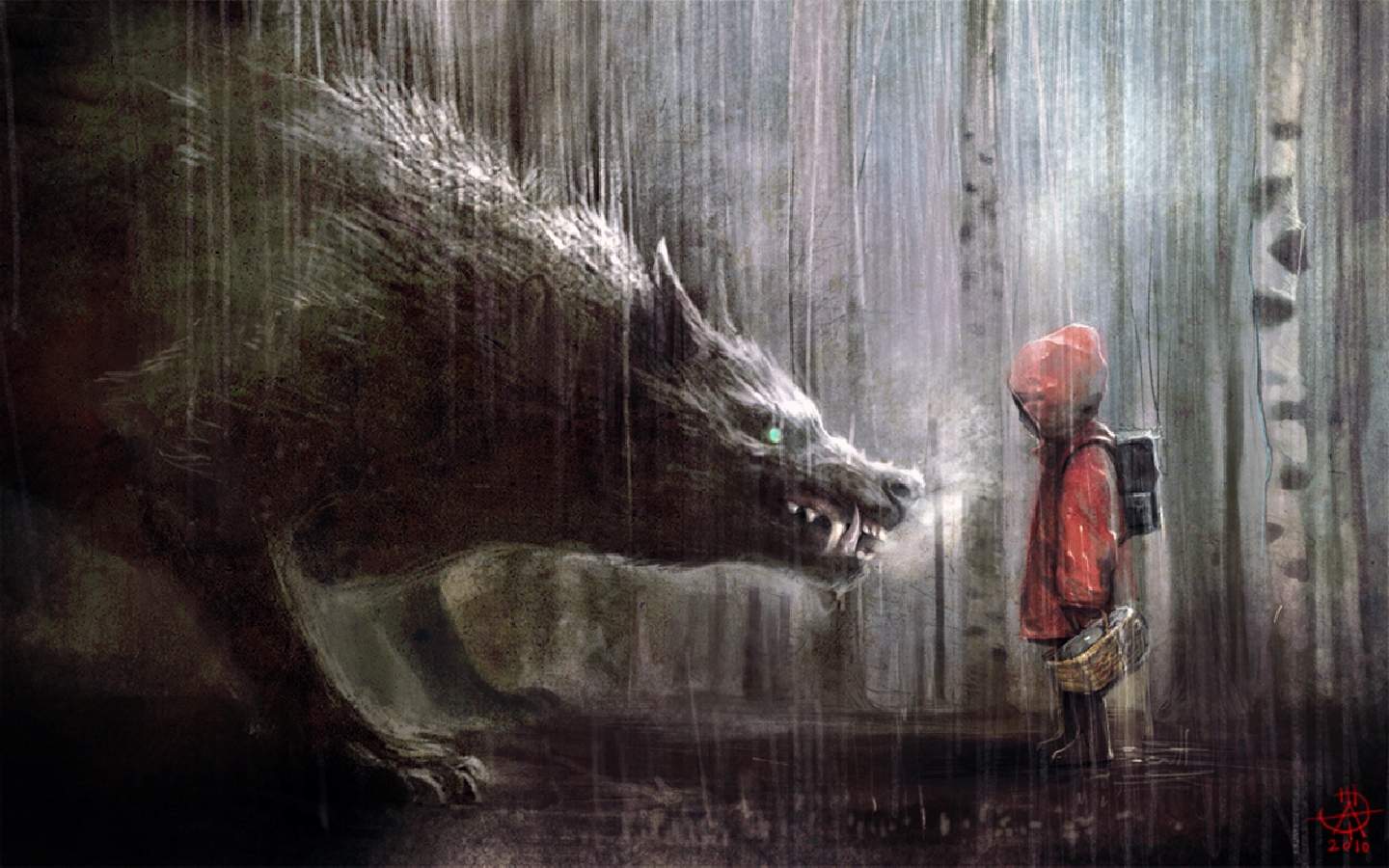
Folk tales, such as Little Red Riding Hood, are full of amazing allegory, warning unsuspecting adolescent girls of the dangers of not sticking to “the path”.  In the original fairytale there is a clear distinction between the safety of the village and the dangers of the forest.  The tale is symbolic of an innocent female victim being lured by a dangerous male criminal from a place of safety to a place of isolation.  Charles Perrault, writer of the earliest version (1697) explicitly explained the meaning of the story at the end:

From this story one learns that children, especially young lasses, pretty, courteous and well-bred, do very wrong to listen to strangers, And it is not an unheard thing if the Wolf is thereby provided with his dinner. I say Wolf, for all wolves are not of the same sort; there is one kind with an amenable disposition – neither noisy, nor hateful, nor angry, but tame, obliging and gentle, following the young maids in the streets, even into their homes. Alas! Who does not know that these gentle wolves are of all such creatures the most dangerous!

There is no doubt in my mind that Little Red Riding Hood is a warning to pubescent girls on the awakening of sexual maturity, the red cloak symbolising the blood of menstruation; the wolf, therefore, a sexual predator.

The literary tale was beautifully brought to life in Company of Wolves, which was an absolute dream for the discerning symbologist (yes, I know it’s a made up title – please don’t write in!).  Unlike the fairytale the charismatic wolf is first encountered as a Prince Charming, later metamorphosing into a wolf.  Throughout the story there are several transformations from human to wolf, introduced through other folk tales within the story.  The main point, according to the old-fashioned thinking of her grandmother’s generation, is for Rosaleen (Red Riding Hood) to be wary of wandering off the path (of righteousness) as there are wicked men ready to take advantage of her.  However, Rosaleen’s mother has a different attitude.  Nowadays it’s okay to run off with the man (or werewolf!) you love.

I leave you with one of my favourite quotes, and the moral of the story, from Charles Perrault’s Little Red Riding Hood:

Little girls, this seems to say,
Never stop upon your way,
Never trust a stranger-friend;
No one knows how it will end.
As you’re pretty so be wise;
Wolves may lurk in every guise.
Handsome they may be, and kind,
Gay, and charming – never mind!
Now, as then, ‘tis simple truth –
Sweetest tongue has sharpest tooth!

Until next week, stick to the path and beware the moon!  Your friend,  A.D.

Footnotes

(1)    Fabing, Howard D. (1956) On Going Berserk: A Neurochemical Inquiry in Scientific Monthly 83 [Nov.] 234.

Fear, Madness and Repressed Sexuality in Dark Fantasy and Horror

Tags

, , , , , , , , , , , , , , ,

vampire4“In a world which is indeed our world, the one we know, a world without devils, sylphides, or vampires, there occurs an event which cannot be explained by the laws of this same familiar world.  The person who experiences the event must opt for one of two possible solutions: either he is a victim of an illusion of the senses, of a product of the imagination – and the laws of the world remain what they are; or else the event has indeed taken place, it is an integral part of reality – but then this reality is controlled by laws unknown to us…   The fantastic occupies the duration of this uncertainty.  Once we choose one answer or the other, we leave the fantastic for a neighbouring genre, the uncanny or the marvellous.  The fantastic is that hesitation experienced by a person who knows only the laws of nature, confronting an apparently supernatural event.” (Tzvetan Todorov:  The Fantastic, A Structural Approach to a Literary Genre, Press of Case Western Reserve University, Cleveland, Ohio 1975 p25).

In order for horror and dark fantasy to be remotely compelling to the reader, it should be somewhat believable and a tad inexplicable, enough to make us feel ‘creeped out’ or on the edge of our seats, at any rate.  Those who read these genres, particularly vampire stories, are often deeply aware of the significance of the literature, if indeed they have not had an experience of sleep paralysis accompanied by hallucination; if hallucination is what demons are, springing from the mind of the victim.  The experience of them is every bit as real as you sitting here reading this blog.  Throughout literary history there have always been souls who understood what vampires and demons symbolised, as well as how to defeat them.

Our most disturbing fears, if awakened, will teach us something of our present circumstances.  These fantastical events never occur without reason.  Like attracts like – negative environments and people very often bring their negative influences to our own psyche.  Our beliefs, fears and unconscious mind do the rest.  By allowing ourselves to remain in that state of mind we open ourselves up to terrifying experiences (or dark energy is attracted to us, whichever you choose to believe).  Either way, writers of dark fantasy and horror are often your guiding light in Hell.

These writers usually have a deep understanding of the Otherworld and reader’s darkest fears.  They take you there in order that you may better understand the many possible dangers and demons that can be encountered in life; and they hopefully end the story with a solution of how to defeat these monsters.

One of the most famous horror writers is Bram Stoker, author of Dracula.  We’ll come to the Count in a minute, but it is interesting that the subject of the disturbed mind is present in the form of Renfield, who has some very important information for the reader.  Note too the eccentric figure of Van Helsing, a slightly mad, but genius doctor, who also has the required knowledge of the fantastic as well as the mundane.  In fact, many of Stoker’s characters question their sanity throughout the story.

Blood, as the mad Renfield informs us, is the life.  By consuming blood, he says, you gain the vital powers of the person whose blood you are draining.  This is proved by his Master – Count Dracula – who becomes younger after drinking the blood of the youthful Lucy.  She becomes weaker, eventually dying, as he becomes stronger.  Mina drinks his blood in some kind of perverse and unholy communion.   Dracula is very clearly placed in opposition to God, and we can assume that he therefore represents the Devil himself.   In fact, Dracula is indeed compared to the Devil several times.  As for Renfield, he is the unfortunate mad man who speaks the truth: the ‘Cassandra’ of this story.

Of course, blood is symbolic of so many things.  On the subject of transubstantiation, in some pagan faiths, such as Sioux, there is a long-held belief that eating the flesh of a certain animal empowers you with that animal’s vital essence and spirit, a superstition that undoubtedly found its way around the world in many other guises.  Bram Stoker was probably aware of the legend of Countess Bathory who, regardless of whether she did or not, supposedly bathed in the blood of virgins to retain her youth (See Footnote 1).  In our modern world, we are well aware that blood transfusion saves lives.  This was only a recent discovery in Stoker’s time, but he does mention, and describe, the procedure in Dracula.   Most importantly, blood symbolises the potent life and energy we possess.  Without it, we die. That life and energy is required so that the figurative vampire may live.  In other words, if we let our fears take us over, or repress our innermost desires, we will be drained, disempowered, possibly depressed and eventually die.

Sleeping and night time are, of course, the places you will encounter vampires and other night demons, and in Dracula it is no different.  Disturbed sleep is touched upon with the somnambulistic Lucy, who is easier to control when she is in this state.  Sleeping people cannot defend themselves, like the state of sleep paralysis mentioned earlier.  It is in this state that people are also very often prone to hallucinations.  This is a condition which has been described for centuries by those who have reported incubus and succubus attacks.  These creatures are night demons who feed upon our energy or have sex with us, in much the same way as Dracula does with Lucy and Mina.  Dracula, therefore, is bound up not only with our fears but also with our repressed sexuality.  The vampire’s teeth penetrating the neck of his or her victim, is symbolic of sexual penetration and shows our deep-rooted primal desire to be fucked.  Hard.  By a sexy, charismatic guy with a castle and pet wolves.  Possibly.  You get the picture.   In the half-asleep world of sleep paralysis we are bound, helpless to our inner desires and fears.  It is then that the vampire is free to strike, and the hallucination takes over.

Never fear, there is hope, and Stoker et al give us some clues on how to defeat the darkness in our lives.  I suppose it’s up to each of us to take what we will out of that, but you’ll have to take a deep breath, pick up the books and face your fears for yourself….

In Sisterhood of the Wolf there is an appearance of a mysterious stranger.  To begin with, he is not identified as a vampire, but there are many tell-tale signs.  He is dark, with penetrating eyes, and there is an enticing quality about him.  Channing knows she should not be anywhere near him, but she simply cannot help herself.  There’s also something strange about Channing which, again, the reader will no doubt suspect long before it happens.  She should be able to smell the stranger from across the street.  That’s some super-power!  Nevertheless, even although she cannot, she still gets a warning, a tingling, before she sees him.  He has a magical super-power too!  He is able to influence her senses and actions.   Channing needs no persuasion to follow his command, even though the impression is of a strong independent woman.

This short opening scene is intended to be sensual, sexual, tense and dangerous.  I have deliberately cut off the reader at this point, hoping it will leave you all wanting more!  What I can say, for now, is that Channing is not scared for her own wellbeing.  She’s a woman well able to take care of herself, and that dark stranger better watch out.  He is about to bite off much more than he can chew!   This is definitely a book for feminists!

Until next week, your friend… A D.

Footnote

1. He was certainly aware of some of the history of eastern Europe, as is evident with his lead character, based on real life Vlad III, Prince of Wallachia, also known by his patronymic name of Dracula.  A name he inherited via his father Vlad II Dracul, a member of the Order of the Dragon.  The real Dracula’s cruelty was renowned, and his preferred method of execution was impalement, where Stoker no doubt derived the classical image of the stake – one of the methods used to kill vampires.

The One Fixed Point in a Changing World

For Sherlock fans. Really the one and only reason I’m posting this is because there is a reference to my friend Donald Robertson in it, which he was equally astonished about! LOL! I suspect someone has given themselves a writing project on Sherlock Holmes and Stoicism as psychotherapy. Or something like that. Anyway, it isn’t the worst thing I’ve ever read.

Click here to read The One Fixed Point in a Changing World by J H Watson (apparently!).

Why I Write Fantasy Fiction and Horror Stories

Welcome to my first weekly blog! From now on, I’ll be blogging an article every Friday. WolfToday I’m going to talk about why I write fantasy fiction and horror stories, so kick back and enjoy.  I hope it’s a learning experience for you.

There’s something incredibly exciting about creating a world where anything can happen, and where you can feel free to express your ideas in an entirely symbolic way.  Some people don’t understand the appeal of fantasy or horror, but that’s probably because they don’t understand the meaning of it.  Once you understand it, fantasy is a magical place of hidden meanings waiting to be discovered and interpreted.

It is, of course, a little bit scary to divulge your innermost thoughts to complete strangers.  However, I find it almost therapeutic to write about the world I see in my mind, and to express it creatively through the fantasy/horror genre.  There is something about injecting the fantastical into writing that brings it to life.  I think the magical feeling we get from fantasy is something we often miss as we leave childhood behind.  Fantasy, I suppose, is an accepted way of allowing ourselves to enjoy those same feelings.  It becomes less scary for me to express my thoughts and the reader is able to experience their fears or immaturity in a safe and mature environment.

One of the many things I love about writing is that I can include a message of some sort.  Of course, you can do this with any kind of writing, but in fantasy and horror it is both subtle and profound.  I love having a place where I can talk about real issues that concern me and show the possible outcomes.  Writing is a hugely powerful medium – the pen is, indeed, mightier than the sword!

Admittedly, the journey of some of my stories makes uncomfortable reading.  However, my stories address real fears that we all have & I always attempt to resolve the situation satisfactorily.  That is not to say that I believe every story must end in a traditionally ‘happy’ way.  I don’t.  That’s not real life.  What I do hope to show, though, is that even if an outcome is not what either the protagonist or the reader would have wanted, or wished for, that there is a silver lining if you think about it.  I think this accurately reflects my own view of life.  In other words, fantasy and horror allows me to take people to their deepest self, to their most petrifying fears and to their unfounded prejudices and it shows them what to do once they get there.

Fantasy writers have been described by some as ‘King’s Fools’, the only people to be permitted to speak the truth.  Is there less need nowadays than in the past to have speakers of truth?  Are we able to speak freely?  Possibly.  It depends where you live.  Do we do anything about injustices, or do we see the terrible wrongs in the world, and yet do very little to change them?  Do we simply turn our heads, and look the other way?  What do we fear and why do we fear it?

What better way to express the idea of e.g. madness than through fantasy and horror?   In “Sleepless” readers are introduced to a horrific character, Zoran, the general of a concentration camp, someone we can barely imagine to be human.  But he is.  He is very human.   We probably often wonder how ‘those evil bastards’ sleep at night.  Well, he doesn’t.   He is tormented by his own demons, rather than being the monster himself.  It is easy to demonise human beings based on their behaviour, but when the question was asked and experiments conducted after the horror of the Holocaust, it turns out most people would follow orders.  In fact, most people would torture, under the right circumstances.

I’m interested in people, what makes them happy, what holds them back, what they fear, what they love and what they hate.  As a pagan, classicist and hypnotherapist, I am aware that many people in today’s society miss out on a whole range of helpful concepts.  Spirituality doesn’t necessarily mean you have to be religious.  Defined as being related to the spirit or soul, I would go further and say that spiritual ideas have a great deal of influence on our mind too.  I have always been interested in the positive psychology of spirituality and religion.  In an age of scientific advancement, we are tending to move away from spiritual matters, but I do not believe the two things are mutually exclusive.  I suppose that is why I am pagan.  My beliefs allow for science.  In all honesty, I cannot say whether I believe in God(s) or not, but regardless of what you believe, the gods exist in “Return of the Olympians” at least, and I hope you will find them as loveable characters as I do.  I have found them to be useful in expressing certain concepts, and I think they bring the stories to life, adding a little bit of supernatural humour.  Besides, I do genuinely respect what each of them stand for.

I am also greatly interested in Gothic Horror and allegorical storytelling which, of course, fantasy encompasses.  I love that characters can be the visible mind, right there in front of you, to gaze at in horrified glory.  As a youngster, I was completely fascinated by vampire and werewolf films.  In truth, I have probably gained more from their visual storytelling than from reading about them.  Metamorphosis is something that has fascinated humans since time began: that is, we can change physically, reflecting the horrific emotional changes one human being may experience, if so cursed.  The idea that evil is entirely visible is perhaps a comfort to us, knowing that we can tell good from bad.  The tragedy of the inevitable downfall of the monstrous leaves us with the comfort that, even if we felt sorry for their plight, it is better they were put out of their misery and mankind could sleep safely at night.  What are these monsters we are so utterly terrified of, though?  Mainly things like unpredictability, sexuality, aggression, mental illness, death, consumerism, nobility, scientific advancement and nature-tampering.  These are all very ancient fears and superstitions that have been with us since the beginning of time.  Monsters are the personifications of our fears, groundless or otherwise.  They show that we are afraid of being eaten, having to give in to our own sexual desires, or those desires of others, being unable to control our inner rage or being sucked dry of life by the ruling classes.  Locations are isolated, because there is danger when we are alone.  We are constantly reminding ourselves, through the figurative monster, that we are vulnerable.  Divided we fall, comrades.

I would like to think that there is something for everyone in my stories.  I certainly try to write like that, rather than home in on a particular audience.  My audience is human beings, and I write because I have something to say to them.  Some will not understand, some may misunderstand but, like any writer, I have a message I would like to bring to the world and I will have done my job if you take something positive from that message.


Excellent article on the modern approach to Stoicism by Donald Robertson, the author of “The Philosophy of Cognitive-Behavioural Therapy” and “The Practice of Cognitive-Behavioural Hypnotherapy”.

Donald Robertson's avatarStoicism and the Art of Happiness

A Simplified Modern Approach to Stoicism

Stoicism and Stoic PhilosophyCopyright © Donald Robertson, 2013.  All rights reserved.

(This is a draft version so we’ll try to incorporate your comments and suggestions.  See my forthcoming book Teach yourself Stoicism, or my previous books on Stoic philosophy and CBT, The Philosophy of CBTand Build your Resilience,for more information.  You can also follow @Stoicweek on Twitter or check out our new Facebook discussion group for Stoicism.)

Please post your comments and questions below or reblog this article on WordPress…

This article is designed to provide a very concise introduction to Stoicism as a way of life, through a simplified set of Stoic psychological practices.  The first few passages of Epictetus’ Handbook (Enchiridion) actually provide an account of some fundamental practices that can form the basis of a simplified approach to Stoicism and this account is closely based on those.  We’d recommend you treat…

View original post 1,325 more words